Like & share

Monday, June 12, 2017

SYLLABUS OF WRITTEN EXAMINATION FOR THE POST OF HEADMASTER HEADMISTRESS OF HIGH/HIGHER SECONDARY SCHOOLS, 2017

STATE LEVEL SELECTION TEST (SLST) 2017
Headmaster  /Headmistress
SYLLABUS OF WRITTEN EXAMINATION FOR THE POST OF HEADMASTER HEADMISTRESS OF HIGH/HIGHER SECONDARY SCHOOLS, 2017
                  Full Marks - 60


The paper will be divided into four PARTS  :

1.   General Awareness and Current Affairs relating to School Education

2.   English

3.   Mathematics

4.   Issues in School Management
Each PART will comprise of fifteen (15) Multiple Choice Question (MCQ) items. Each MCQ item will have four options, out of which one will be the correct one and other three will be incorrect. The candidates will have to mark the correct answer. Each MCQ will carry ONE (1) mark. The Question Paper will be of Sixty (60) marks, and it will be of ONE (1) hour duration. There shall be no NEGATIVE marking

Details of Syllabus and Question Pattern are given below.
PART -1


 General Awareness and Current Affairs relating to School Education

15 Marks
This   part  , divided into three  Sections  , aims to test candidates' knowledge pertaining to traditional & modern trends in educational philosophies, theories and practice at international, national and state (West Bengal) levels.
Section - A Five Issues related to International Level:
1.   Educational philosophies of John Dewey, Burrhus Frederic Skinner, Piaget, Vygotsky &  Kenneth Robinson.
2.       Bloom's Taxonomy (1956) & Revised Bloom's Taxonomy (2001) by Anderson & Krathwohl and their relation to Learning, Teaching& Evaluation, including theories of multiple intelligences & Delor's Report on Education 'Learning: The Treasure Within'.
3.       Cognitive and Social Constructivism and their impact on classroom transaction including Constructive models of teaching-learning process.
4.       Use of ICT in classrooms.
5.       Major Educational Initiatives & Projects, related to school education, of the United Nations from 2014 to 2016.

Section - B
Five Issues related to National Level:
1.   Educational philosophies of Mahatma Gandhi, Rabindranath Tagore & Jiddu Krishnamurti.
2.       Major recommendations of Radhakrishnan Commission (1948-49), Mudaliar Commission (1952-54) & Kothari Commission (1964-66) and impact of those recommendations on School Education.
3.       National Education Policy (1986) - main features
4.       Programme of Action (1992), Yash Pal Committee Report titled 'Learning Without Burden' (1993), including concepts of Inclusive Education.
5.       Visions of the National Curriculum Framework (2005), SSM, RMSA and mandates of The Right of Children to Free and Compulsory Education Act, 2009 related to School Education.
Section-C
Five Issues related to State Level:
1.       Educational philosophies of Vidyasagar, Vivekananda & Rishi Aurobindo.
2.       Major Educational Initiatives for schools & school students in West Bengal from 2011 to 2016.
3.       Approaches to New Curriculum, Syllabi & Textbooks at Elementary, Secondary & Higher Secondary levels followed in the state.
4.    Characteristics & Implications of the Continuous & Comprehensive Evaluation (CCE) structure (The Peacock Model) followed in the Elementary level.
5.       The Evaluation structure at the Secondary level (including Internal Formative Evaluation) & Evaluation structure at the Higher Secondary level (including Project) followed in the state.


Question Pattern:


Section
Number of Issues
Marks in Each Question
Number of Questions
Total Marks
A
5
1
5 (One question from Each Issue)
5
B
5
1
5 (One question from Each Issue)
5
C
5
1
5 (One question from Each Issue)
5

PART - II                                                     15 Marks


English
This   part  , divided into three  Sections , will contain questions related to Comprehension, Grammar & Vocabulary.

Section - A Comprehension:
One passage, not more than 200 words, will be given. Questions will be set on this passage.

Section - B Grammar:
Topics:
1.       Gender Change
2.       Number Change
3.       Proper Verb forms
4.       Articles
5.       Prepositions
6.       Voice Change
7.       Narration Change
8.       Phrasal Verbs
9.       Locating errors in sentence construction
Section - C
Vocabulary:
Topics:
1.       Synonyms
2.  Antonyms
Question Pattern :
    
Section
Section Topic
Marks in Each Question
Number of Questions
Total Marks
A
Comprehension
1
4
4
B
Grammar
1
9 (One question from Each Topic)
9
C
Vocabulary
1
2 (One question from Each Topic)
2

loading...
PART - III   Mathematics   15 Marks

1.      Prime number, Composite number, Even number, Odd number. Integer, Simple fraction, Decimal   fraction. Addition, Subtraction, Multiplication, Division of rational numbers and Square root of rational numbers and simplification involving the above operations. Order relation on rational numbers.
2.             H.C.F & L.CM of rational numbers.
3.             Percentage.
4.             Metric system.
5.             Time and distance.
6.            Time and work.
7.            Ratio and proportion.
8.            Simple interest.
9.            Compound interest.
10.     Partnership business.
11.     Profit and loss, Discount.
12.     Area and Perimeter of rectangular region, triangular region and circular region.
13.     Total surface area and volume of a solid cuboid, solid cylinder, solid cone and solid sphere.
14.     Mean or Average.
15.     Pythagoras theorem.
16.     Factors of quadratic expression.

17.    Simplification of algebraic expression.
18.    Solution of linear equations with two variables.
PART - IV Issues in School Management
15 Marks
This PART is divided into following three sections.
SECTION - A
1.   Admission and Students' Welfare
a.    Admission at Elementary Level
b.   Admission in Class IX Onwards
c.    Entitlement of Children under the RTE Act, 2009 and Entitlement declared by Department of School Education, Govt. of West Bengal
2.   Safety of Children in School and Protection of Child Rights
a.    Health Safety & Disaster Management
b.   Physical, Emotional and Mental Safety
c.    Child Rights as per Provisos of RTE Act, 2009
3.   Management for Equality
a.   Girls Education and Equity as per Provisos under RTE Act, 2009


            b.   Avoiding Discrimination against Girls.
c.    Access and Retention for the Girls Child
d.   Aids and Appliances for Children With Special Needs (CWSN)
e.    Issues related to Inclusion of Children from Marginalized Communities, ST Children and Minority Children.
f.    Identification of Children in Difficult Circumstances and Migratory Children.
SECTION -B
1.   Management for Quality of Learning
a.    Curriculum and Evaluation as envisaged in RTE Act, 2009
b.   Learning Environment
c.    Teaching-Learning Process, including Comprehensive and Continuous Evaluation (CCE) with reference to PEACOCK Model followed in West Bengal and Planning of Learner's Assessment to ensure Learning Outcomes at Secondary & Higher Secondary levels.
d.   Transaction of Curriculum.
2.   Supervision and Support at the School Level for Monitoring of Quality
a.    Maintenance of Child Friendly and Child Centric Environment
b.   Classroom Observations
c.    Organization of 'Co-scholastic' Activities and their Integration in the School Curriculum
d.   Maintenance of Child Profile
e.    Management of Discipline in School

SECTION- C
1.   School Management
a.    School Managing Committee
b.    School Development Plan
c.    Staff Pattern of Different Schools
d.    School Time Table and Annual Academic Calendar.
e.   Financial responsibilities of the Head of the Institution.
f.    School Records
g.    Coordination between School and Community
2.   Some Acts and Rules in West Bengal regarding Management of School
a.    The West Bengal Board of Secondary Education Act, 1963
b.   The West Bengal Council of Higher Secondary Education Act, 1975
c.    The West Bengal Schools (Control of Expenditure) Act, 2005
d.   The West Bengal Panchayat Act, 1973
e.    The West Bengal Municipal Act
f.    West Bengal Right of Children for Free and Compulsory Education Rules, 2012.

g.         Compositions of the West Bengal Board of Secondary Education and the West Bengal Council of Higher Secondary Education

h.   Procedure for Recruitment of Teaching/ Non- Teaching Staff, Appointment,Approval and their Confirmation.

i.    Break-in Service, Condonation, Lien, Leave Rules.

 j.    Resignation, Termination and Dismissal
 k.   Service Rules of Teaching/Non-Teaching Staff including Pension matters and Retirement Benefits
l.    Grant-in-Aid Rules, Treasury Functions, House Rent Rules, Arrear Claims.
m. GPF&CPF Rules, Change of Option.
n.   ROPA - Various Aspects - Fixation of Pay, Change of Option o.   Staff Patterns of Different Schools
Question Pattern:

Section
Number of MCQ items
Marks in each item
Total Marks
A
5
1
5
B
5
1
5
C
5
1
5


Friday, June 9, 2017

Online Salary management System OSMS


From today online salary management website OSMS v2 open for all from today. Every one should know what to do for first time.  

1. First change your default password .


2. Check whether the school profile data is correct or not. If any correction required then make the changes and then save it . It was said in training that an OTP will come to HM mobile while finalised the salary bill. But still now the system is not available. 

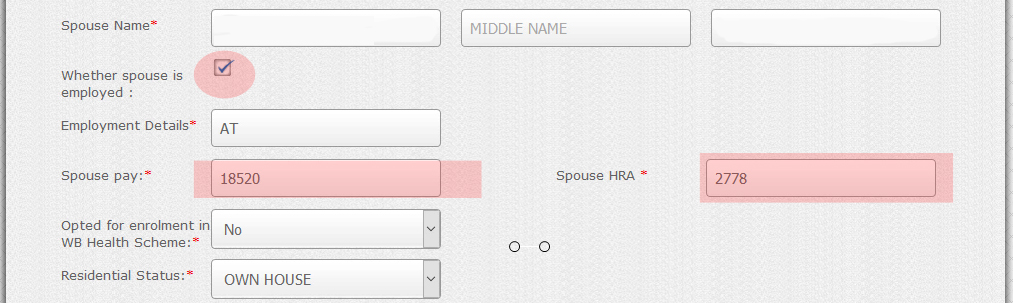
3. Every employee profile need to add the first joining date in service and the status of spouse if spouse is in service for HR allowance. If spouse HRA not entered correctly then the employee HRA will display incorrect . In salary table there is no place to change HRA.


loading...


Watch the video for more  https://youtu.be/ybks_8RzVp0


How to apply form online transfer

 
Key : #OSMS , # Online_Salary_Management, #WBSED, wbsed.gov.in , I-osms, west Bengal Education Department  

Thursday, June 8, 2017

New Tax rates under GST: The gains and losses for the Indian common people


GST will introduce from 1st July 2017. In various sectors the tax rate increase and in various sector it decrease. The common man is calculating the effects of GST. Look at a glance what increased and what decrease.
Gold: GST Council has fixed the tax rate of the precious metal at 3 per cent. GST Council on June 3 created a new tax bracket for gold, diamonds and silver. The current excise duty on gold was 1 per cent and 1 per cent VAT in many states. With 3 per cent GST, Gold is set to become costlier July onward.
Insurance: Premiums are set to rise on car, health and and term insurance with the government. Currently, insurance is taxed at 15 per cent. Under GST, this would go up to 18 per cent.

Banking Charges: Transaction fee on various banking and financial services are expected to go up as GST will tax these services under 18 per cent tax rate from the current 15 per cent.

Hotel Bookings: GST on hotel services will depending on the kind of room you stay in. If the room tariff is less than Rs 1,000, your stay will be tax free. However, if the room tariff is between Rs 1,000 - Rs 2,500, you'll be taxed 12 per cent. It the tariff is between Rs 2,500 to Rs 5,000, the stay will be taxed at 18 per cent. For luxury hotels, where the tariffs are more than Rs 5,000, GST rate of 28 per cent will be applicable.
Eating Out: There are different tax slabs for restaurants depending on their turnover and whether they have air-conditioning or or not.

Telecom Bills: Your mobile and internet bills are expected to rise once GST comes into force. Currently, there is a 15 per cent service tax on telecoms services. Under GST, the tax rate applicable will be 18 per cent. The industry, which is already stressed with the launch of Reliance Jio, is expected to pass on these charges to customers.

Movie Tickets: During a GST Council meet in Srinagar, Finance Minister Arun Jaitley had said movie tickets in cinema halls will be taxed at 28 per cent.
Currently, there is service tax on cinema and states have separate entertainment taxes. Maharashtra levies more around 50 per cent entertainment tax on movie tickets. In Uttar Pradesh (UP) entertainment tax is around 30-40 percent.
Even though the tax rate under the GST will be lower than entertainment taxes levied in some states, movie ticket prices in big multiplexes may remain same as the government plans to increase tax on junk food and aerated drinks.

Medicines: While there may not be a huge impact of GST on medicines, but a tax rate of 5 per cent on life-saving drugs that treat diseases like malaria, HIV-AIDS, tuberculosis, and diabetes is expected to marginally increase prices of these drugs.
Until now, these drugs were exempted from excise and customs duties. However, a few states were charging 5 per cent tax on these drugs which will now be subsumed under GST. Under GST, there will be a 12 per cent on formulations and 18 per cent on APIs (active pharmaceutical ingredients) - the bulk drugs that go into the making of final pills and tablets.

Cab rides: Cab fares could get marginally cheaper for customers from July 1 as the incidence of tax will come down to five per cent for bookings made on cab aggregators like Ola and Uber. Currently, a tax of six per cent is levied on rides booked through cab aggregators.

loading...
Tobacco products: Filter and non-filter cigarettes not exceeding 65 mm will attract cess of 5 per cent plus Rs 1,591 per 1000 sticks. For cigars, a hefty levy of 21 per cent or Rs 4,170 per 1000 sticks, whichever is higher, would be levied. Branded gutkha will be slapped with a cess of 72 per cent, while smoking mixtures for pipes and cigarettes will attract a levy 290 per cent.
Bikes: Motorcycles of more than 350 cc engine capacity will attract a total of 31 per cent tax under the GST regime, same as the tax incidence on private aircraft and luxury yachts.

Cars: All cars fall in the 'luxury bracket' of GST. That means they will attract 28 per cent tax. However, depending on their size, extra cess will be levied.
Small cars or cars under four-metre length powered by a petrol engine not greater than 1.2-litre or a diesel engine not greater than 1.5-litre by displacement will be taxed at 28 per cent. For petrol cars, the effective tax rate will be 29 per cent. However, for diesel cars the effective tax rate will be 31 per cent.
The government said it would tax hybrid vehicles at a rate as high as 43 percent. This would be significantly higher than the prevailing tax of about 29 percent on such cars.Air Travel: Economy class air travel will become cheaper with tax rate fixed at 5 per cent against the existing 6 per cent, under the upcoming goods and services tax (GST) regime from 1 July. However, for those travelling business class, tickets will become dearer as the tax will go up from 9 per cent to 12 per cent.

No Tax Items: Daily items like milk, paneer and curd won't be taxed under the GST. The GST Council decided not to tax metro travel, religious travel and Haj yatra under the new tax structure. There won't be any tax on healthcare and education under the new taxation system. Basic food items like cereals, eggs and meat will attract no tax after the GST is effective.
Prices of food grains, especially wheat and rice, will come down as they will be exempt from the GST. However, packaged food items will be taxed at 5 per cent.

Coal: electricity generation will get cheaper as the GST council has brought down the current tax on coal to 5 per cent from the current tax rate of 11.69 per cent. Sweets will attract 5 per cent tax under the GST.
Daily use items: Household items like sugar, tea, coffee (barring instant coffee) and edible oil will attract the lowest tax rate of 5 per cent, almost the same as under the current tax structure.
Common use products like hair oil, soaps and toothpaste will be charged with a single national sales tax or GST of 18 per cent instead of present 22-24 per cent tax.

Meat: Animal slaughtering and services provided by veterinary clinics will be exempt from GST. Entertainment: Visits to theme parks and sporting events like IPL will attract a levy of 28 per cent under the new indirect tax regime kicking in from July 1.Railways: Non AC train travel, including in local trains and metro, has been exempt from GST, while AC train travel will attract 5 per cent service tax. Ticket prices for AC trains will increase marginally as current service tax is at 4.5 per cent.

Maintenance Charges: Flat owners who pay Rs 5,000 or more every month as maintenance charges, excluding property tax, stamp duty and utilities charges, will have to pay GST on the increased tax rates. As of now, tax levied is levied at 15.55 per cent on maintenance charges, which will be replaced with 18 per cent after GST is implemented.

Smartphones: A smartphone currently attracts two per cent central excise duty, besides the value-added tax (VAT), which vary from state to state (five per cent to 15 per cent). Under GST, smartphones will be taxed at flat 12 per cent.

Cement: Prices of packaged cement is expected to come down marginally as it would be taxed at 28 per cent under the GST as against 31 per cent currently on account of different indirect taxes.
Ayurveda: Ayurvedic products are set to get costlier as the government has kept these products in the 12 per cent bracket. Ayurveda products currently attract a 8-9 per cent levy.

West Bengal SSC SLST 2016 Syllabus pdf Download Available here

  পশ্চিমবঙ্গ স্কুল সার্ভিস কমিশন (WBSSC) ২০২৫ শিক্ষক নিয়োগের বিজ্ঞপ্তি প্রকাশ করবে। সেই বিজ্ঞপ্তি অনুসারে, পশ্চিমবঙ্গের বিভিন্ন মাধ্যমিক বি...